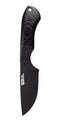
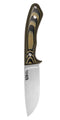
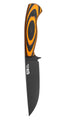
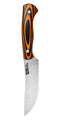
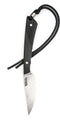

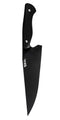
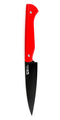
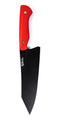
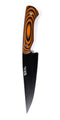
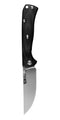

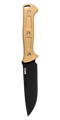
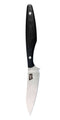

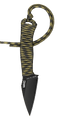
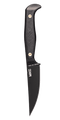
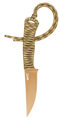
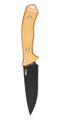


Master Bladesmith and Montana Knife Company CEO Josh Smith has been building custom liner lock knives by hand for 30 years. Each one costs $10,000–$30,000 and takes hours of hand-fitting, hand-grinding, and hand-finishing to get right.
The Montana is what happens when those three decades meet a new 51,000-square-foot facility designed to produce it at scale.
This is MKC’s first production folding knife. It didn’t come fast, and it didn’t come easy.
It took dozens of prototypes, years of revisions, and a purpose-built facility. That facility holds custom machines, a vacuum furnace for in-house heat treatment, and a team hired specifically to close the gap between a $30,000 custom knife and a production folder that sacrifices none of the quality. We refused every shortcut.
The Montana started as a sketch and became an obsession. This is what emerged.

Built Light for Everyday Carry
The Montana is an everyday carry knife. We designed it from the start for pocket-friendly carry, thin and light at 2.84 ounces, with a blade that weighs under an ounce on its own.
We built it for the moments you reach for a blade throughout the day: opening packages, cutting cord, slicing through zip ties, and the small precision tasks that stack up between Monday and Friday. The trailing point blade and full flat grind are optimized for slicing performance above all else.
Full-length stainless steel liners run the width of the handle, giving the frame a rigidity you feel the second you pick it up.
A Lock You’ll Stop Thinking About
We didn’t invent the liner lock. The design dates back to the early 1900s and was popularized by Michael Walker in the 1980s. What we did was take a mechanism Josh had been building by hand for three decades and engineer it for precision manufacturing without losing what made his customs special.
Most liner locks fail in the same spot. They rely on a thin piece of metal that bends under load, creating a mushy feel or, worse, easy failure.
We engineered the Montana’s lock to put forces into compression, not bending. The blade forces run directly along the liner’s root, where the frame is most supported. Forces on the blade sit perpendicular to the pivot axis for maximum effective use of the lock bar.
We engineered every force to flow through the knife’s strongest part, not the weakest. The liners themselves are harder than the industry standard by two to four points. That extends the life of both critical wear points: the ball bearing interface and the lock face against the blade.
A hardened stainless-steel pivot, ground to a cylindrical shape for precision and longevity, holds it all together. The result is a lock that does its job and gets out of your way.
Moves When You Want It to, Stays Put When You Don’t
The Montana’s folding action rides on custom silicon nitride ball bearings in a bronze cage, manufactured specifically for this knife.
These aren’t off-the-shelf components. The oversized bearings are sized for a quarter-inch pivot, even though the Montana runs a 3/16″ pivot. This means the bearings act at a larger working radius on the blade, making the mechanism feel more rigid and more stable than standard configurations.
The feel is smooth and buttery on the open, with a crisp detent that lets you know when the blade is seated. Once locked up, the blade doesn’t move.
Open, closed, locked: every position feels intentional. When the blade isn’t supposed to move, it doesn’t. When it’s supposed to move, it moves smoothly.
Custom barrel spacers with shoulders on both sides mate into pockets in the liners, guaranteeing perfect lateral alignment during assembly. Most companies use straight barrels with no shoulders. We added them so the two halves come together true every time.

Cut Effortlessly, Resharpen Easily
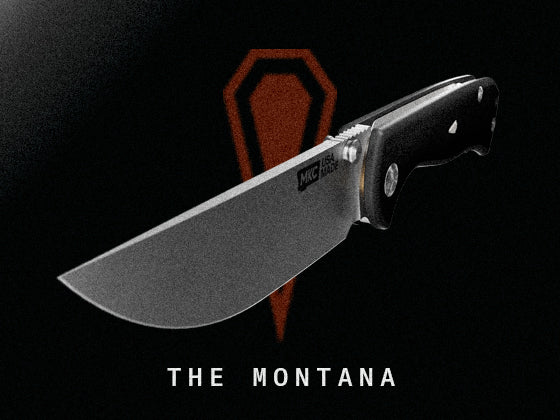
The Montana’s slight trailing point blade pays homage to the tools Josh has traditionally built by hand. The signature upsweep shares DNA with the Speedgoat’s blade profile, giving the Montana a look that’s distinctly MKC.
The blade features a stonewash finish and a surgical tip, built for detail work, controlled cuts, and the precision tasks you reach for in an EDC. The full flat grind produces the thinnest edge we’ve ever put on a blade, ground to 10 thousandths of an inch, thinner than even the Mini Speedgoat.
MagnaCut stainless steel, cryogenically heat-treated, makes up the blade. Developed by metallurgist Larrin Thomas, PhD, MagnaCut gives you edge retention and toughness without the trade-offs typical of stainless steel, plus a blade that’s easy to resharpen when the time comes.
Precision You Can Feel in Every Component
Look at how the Montana’s thumb stud is mounted. It sits in a machined pocket on the grind itself, not on a flat. No other companies do this, and for good reason: it requires machining while the blade is hardened, one of the most difficult operations on the entire knife.
We grind the blade, harden it, bevel grind it, and then go back into the mill in the hard condition to machine the counterbores for the thumb studs, the lock face, and the detent pocket. The last time we touch the blade, we put in the features we care about most. It’s harder and more precise.
The thumb stud itself is a pedestal style with machined steps for grip. We positioned it for balance: easy to deploy even with gloves on, but not so prominent that it catches on your pocket or opens accidentally.
Deceivingly Thin, Fully Contoured
The Montana’s G10 handle scales sit over full-length stainless steel liners, giving you rigidity through the frame. Injection-molded handles on competing folders aren’t even this thin, and those don’t have full liners behind them.
We 3D-milled the handle with curvature in both directions, then milled micro-texture back in. The texture provides enough grip for dexterity and pocket retention without snagging fabric or ripping pockets. G10 won’t crack, warp, or degrade over time, and all hardware is titanium.
One side of the handle features an inlaid arrowhead, a nod to MKC’s deep ties to archery dating back to the company’s earliest days. It’s not decorative filler. Underneath it sits a hidden structural screw that cinches the liner to the handle at the mid-span for added rigidity.
Easy In, Easy Out
The Montana’s fold-over deep carry pocket clip is made from 420 stainless steel and falls in a sweet spot: not too long, not too short.
We used flat-head screws with countersunk holes so the hardware sits flush with the handle surface. Most companies reuse round-head screws from other parts of the assembly, and those bump up in your pocket and bunch fabric under the clip.
The Montana’s clip hardware eliminates that. Smooth in, smooth out.
Quality Controlled at Every Step, Start to Finish
A typical MKC fixed blade has around seven parts and 14 manufacturing operations. The Montana has 25 parts and 41 operations, nearly three times the complexity.
Each of those 25 components follows its own manufacturing workflow and supply chain before converging in our facility for assembly. The folder blade alone goes through more operations than an entire fixed blade knife. Raw steel enters one end of the facility, progresses through laser cutting, milling, heat treatment, grinding, mass finishing, and final machining, and a finished knife exits the other end.
MKC controls virtually every critical manufacturing process in-house, in one building. The number of U.S. knife companies producing nearly all components for a folding knife model on site is extremely small. Outside of MKC, you can count the others on one hand.
Free Sharpening for Life and Beyond
MKC Generations® is our promise to restore your knife to its original, unmatched working condition.
We’ll clean, sharpen, repair, and even reshape your blades when necessary, all free of charge. While we perform all necessary sharpening and maintenance, our aim isn’t to make your knife look brand new. The wear tells your knife’s story of daily use, and we respect that.
The MKC Generations® promise follows the knife, not the original owner. Pass it down, and the warranty goes with it.
The Next Chapter Starts Here
We made every engineering decision on the Montana for longevity: harder liners, a ground pivot, optimized force paths, precision bearings, and custom hardware throughout.
We didn’t take any shortcuts on this knife. We gave ourselves every manufacturing difficulty we could find, and the result is a folder we’ll support for the life of the knife, which we built to outlast its owner.
This is the beginning of the second chapter of Montana Knife Company. It took longer than almost any knife we’ve designed, and it pushed us out of our comfort zone on every part.
It’s the knife we’ve wanted to build since day one.
by Josh Smith, Master Bladesmith and Founder of Montana Knife Company