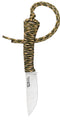
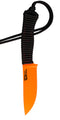
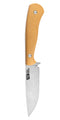
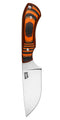
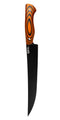
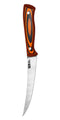
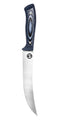
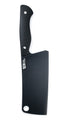
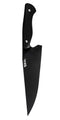
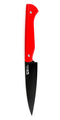
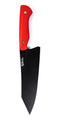
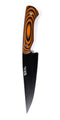

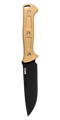
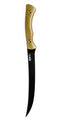
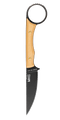





The fixed blade vs. folding knife debate has been going on for decades, and it’s the wrong conversation. Picking one over the other is like choosing between a truck and a sedan. Both get you where you need to go, but they do it differently, and most people are better off with access to both.
The smarter approach is knowing when each type earns its spot on your belt or in your pocket. We’ll break it down by scenario, construction, blade geometry, and carry style so you can make an informed call.

The Real Difference Between a Fixed Blade and a Folding Knife
A fixed blade is the knife you bring when you know you’ll need a knife. Hunting, camping, bushcraft, field dressing: you’re choosing a specific tool for a planned task. The blade is always deployed, always ready, and built to take sustained use without a mechanical failure point.
A folding knife is the one you carry “just in case.” It lives clipped to your pocket, goes where you go, and handles the unplanned moments: opening a package, cutting cord, breaking down a box, etc. You don’t plan your day around it, but it’s there when a task pops up.
The fixed blade vs. folding knife distinction drives every other buying decision, from blade shape to steel type to how you carry it.
Where Fixed Blades Have the Edge
The advantages of a fixed-blade knife come down to one word: simplicity.
A fixed blade has no lock to fail, no pivot to wear, no springs to break, and no joints where grit and debris can hide. The blade and handle are one continuous piece of steel. That means there are fewer failure points under hard use, and no disassembly is required after a messy job.
Cleanability is a bigger deal than you may think. If you gut a fish or skin a coyote with a folding knife, you’re pulling it apart afterward to clean blood, fat, and debris out of the pivot and lock mechanism.
One of our team members took a Benchmade folder out on a coyote hunt years back. It worked great for skinning, but he spent half an hour disassembling and bleaching it afterward. By contrast, a fixed blade goes under running water and comes out clean.
Bear hunters face the same challenge. Bear fat is sticky and gets into every crevice of a folder. With a fixed blade, cleanup takes seconds.
Why Folding Knives Win for Everyday Carry
When you’re not in the field, a folding knife’s portability can’t be beat.
Clip it to your pocket, and it disappears against your body. No sheath on your belt, no handle sticking up past your waistline. You don’t have to think about it until you need it.
For most everyday tasks, a folder is all you need. You can open packages, cut zip ties, and slice an apple at lunch. You’ll get through 99% of daily cutting tasks without ever wishing you had a fixed blade.
The social factor matters, too. Pull a fixed blade from your pocket in an office, a coffee shop, or at a friend’s barbecue, and you’ll get some looks. Carry a folding knife, and most people never know it’s there.
In urban environments, that perception matters. A folder doesn’t broadcast that you’ve made an effort to carry a knife.
Fixed Blade vs. Folding Knife: Quick Comparison
|
|
Fixed Blade |
Folding Knife |
|
Strength |
No mechanical failure points |
Lock dependent; solid under light to moderate use |
|
Portability |
Requires sheath or belt carry |
Clips to pocket, disappears on your body |
|
Cleanup |
Rinse and dry |
Disassembly needed after messy jobs |
|
Social Perception |
Visible, can draw attention |
Discreet, often unnoticed |
|
Weight |
Varies; ultralight options exist |
Compact and lightweight |
|
Deployment |
Always ready |
Requires opening mechanism |
|
Best For |
Planned, purpose-driven tasks |
Unplanned, everyday tasks |
Pick a Fixed Blade or Folding Knife for Your Scenario
The fixed blade vs. folding knife decision changes depending on where you are and what you’re doing.
Everyday Carry (Urban/Suburban): A folding knife handles any task you’ll encounter in daily life: boxes, packaging, tags, food prep in a pinch. You don’t need a fixed blade in the city for routine tasks.
Hunting: Carry both into the field. Your folder stays clipped to your pocket for camp tasks: opening packaging, cutting rope, eating, etc. Your fixed blade comes out when it’s time to process an animal.
Most hunters carry at least three knives in the field, and a folder paired with a dedicated skinning knife covers the most ground.
Camping and Backpacking: A folder on your person, a fixed blade in your pack. If you’re counting ounces on a long hike, the folder handles most needs.
The fixed blade is your backup for heavier tasks and for redundancy. If you lose one, you still have the other.
Tactical/Self-Defense: A fixed blade deploys instantly with no fumbling, no mechanism to engage. In a high-stress situation, that simplicity is a major advantage. Folders can fill a self-defense role, but they’re not designed for it.
Trades and Construction: Folding knives get the most use on job sites: cutting sheetrock, stripping wire, scoring materials, etc. A replaceable-blade utility knife is often the better call for heavy-abuse trade work, but a good folder handles lighter tasks all day.
How Fixed Blade vs. Folder Construction Affects Durability
A fixed blade is the simplest knife you can build: a blade, a handle, and fasteners holding them together. That simplicity means fewer failure points over years of use.
Folding knives have pivots, bearings, lock mechanisms, springs, and hardware that all experience wear. A well-built folder will last for years with proper maintenance, but it’s a more complex tool. Salt water, sand, blood, and fat can work their way into the mechanism and cause issues if you’re not staying on top of cleanup.
The tradeoff is clear: a fixed blade gives you worry-free reliability under hard use. A folder gives you pocketability and convenience, with a small maintenance tax.

Choose Blade Shape and Steel for Fixed Blades vs. Folders
Blade shape selection works differently for folders and fixed blades, and the right choice depends on the tasks you perform most.
With a folding knife, it’s a matter of personal preference matched to your daily tasks. A trades worker who opens paint cans and scrapes gaskets all day gravitates toward a tool with a blunt tip. Someone who mostly opens packages and cuts cord does fine with a standard drop point or clip point.
The other consideration is pocket real estate. A folder shares space with your keys, phone, and wallet, so the closed profile matters as much as the blade shape.
With a fixed blade, the choice is more purpose-driven. You’re selecting a blade geometry built for a specific set of tasks: a drop point for general hunting utility, a trailing point for skinning, a clip point for piercing and detail work, etc. The blade shape maps to the job.
Steel selection follows a similar pattern. You’ll typically carry a folder daily and put it through moderate use, so corrosion resistance and ease of resharpening matter. On a fixed blade built for hard field use, toughness and edge retention take priority.
Pair a Fixed Blade and Folder to Cover Every Task
Start with the tasks you perform most often. Then pick a folder and a fixed blade that cover different ground.
The worst pairing is two knives built for the same purpose. If your folder and your fixed blade both have the same blade shape and handle the same tasks, one of them stays in the drawer.
A good pairing gives you full coverage. Your folder handles everyday tasks: packages, food, rope, camp chores, etc. Dedicate your fixed blade to field work: processing game, batoning kindling, and heavier cutting jobs.
Think of it like a one-two punch. The folder is always with you, and the fixed blade comes off the bench when the job calls for it.
Between the two, you’re covered for a desk job and a backcountry elk hunt alike.
by Josh Smith, Master Bladesmith and Founder of Montana Knife Company