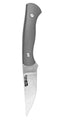
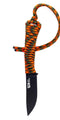
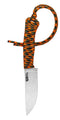
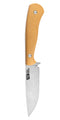

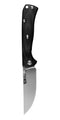

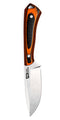
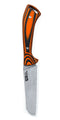

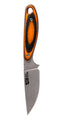

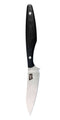






Damascus steel is a blade material known for its distinctively wavy, water-like patterns and legendary reputation for strength and sharpness.
Bladesmiths create modern Damascus steel by layering two different steel alloys (typically a high-carbon steel and a high-nickel steel), then heating, folding, and forge welding them together to form one solid billet. The result is a blade that’s as beautiful as it is functional, with patterns that run through the entire piece of steel, not just on the surface.
I started working with Damascus steel as a teenager, and I’ve now been at it for more than 25 years. In 2000, I won the “Best Damascus Knife” award at Blade Show Atlanta, the world’s largest knife show, and I went on to become the youngest Master Bladesmith certified by the American Bladesmith Society.
Needless to say, I know this material well, and I’m packing all I’ve learned into this guide.
The History Behind Damascus Steel
The original Damascus steel (often called wootz steel) originated in India and Sri Lanka around 300 B.C. Swordsmiths in the Middle East, particularly in the Syrian capital of Damascus, became famous for crafting this steel into legendary blades.
When Crusaders returned to Europe during the Middle Ages, they brought back tales of fearsome swords that could supposedly slice through a falling silk scarf or cut through European blades without losing their edge. These weapons were sharper, harder, and lighter than what European blacksmiths could produce at the time.
The original wootz Damascus steel had a distinctive “watered” pattern that appeared naturally during forging, created by the metal’s crystalline carbide structure. Unfortunately, bladesmiths lost the exact technique for making this original Damascus steel sometime around the 18th century.
Some historians believe the ores used in India changed, cutting off the supply of the specific material that made wootz possible. Others point to the decline of Middle Eastern trade routes as European colonial powers disrupted the flow of steel ingots from South Asia.
The art of pattern-welded Damascus saw a major revival in America in the 1970s when bladesmith Bill Moran began exhibiting pattern-welded blades at knife shows. Moran’s work reignited interest in the technique and inspired a generation of bladesmiths, including me, to pick up the craft.

Modern Damascus Steel vs. Historical Wootz
When we talk about Damascus steel, we’re usually talking about pattern-welded steel, not the original wootz Damascus. Both versions are “real” Damascus steel, but bladesmiths create them through different processes.
|
Feature |
Historical Wootz Damascus |
Modern Pattern-Welded Damascus |
|
Origin |
India/Sri Lanka, ~300 B.C. |
American revival, 1970s onward |
|
Process |
Single ingot of crucible steel, smelted |
Multiple steel alloys layered and forge-welded |
|
Pattern Source |
Carbon nanotubes and carbide formations at the microstructure level |
Contrast between different steel alloys revealed by acid etching |
|
Steel Control |
Limited (dependent on ore quality) |
Precise (bladesmiths select specific alloys) |
|
Reproducibility |
Lost to history (partially reconstructed by researchers) |
Fully reproducible by skilled bladesmiths |
|
Performance |
Legendary but inconsistent |
Consistent and often superior due to modern alloys and heat treatment |
Many modern Damascus steel blades outperform historical examples because we have access to cleaner, more consistent steel alloys and precise heat-treatment methods that ancient bladesmiths couldn’t dream of.
How Bladesmiths Make Damascus Steel
Creating Damascus steel is equal parts science and art. Here’s how I do it.
1. Selecting the Steels
You can’t make Damascus steel from just any metal. You need two steels that weld together properly and create a visible contrast after etching.
The most common combination is 1080 high-carbon steel paired with 15N20 nickel steel. The nickel content in 15N20 resists acid etching and stays bright, while the 1080 darkens, creating that classic layered look.
2. Building the Billet
I stack the different steel bars in alternating layers to create what’s called a billet. Think of it like stacking red Play-Doh on top of yellow Play-Doh. If you used the same color throughout, you’d just end up with one solid color.
The contrast between the steels makes the pattern visible.
3. Forge Welding
I heat the billet to approximately 2,300°F, then weld it together under a hydraulic press or with a hammer. At this temperature, the two steels bond into one solid piece.
This step demands precision: too hot, and you risk burning the steel; too cool, and the layers won’t bond properly.
4. Folding and Layering
I draw out the welded billet, fold it over, and weld it again. Each fold doubles the layer count. A billet that starts with eight layers becomes 16, then 32, then 64, and so on.
Bladesmiths often aim for 200 to 500 layers, depending on the desired pattern.
5. Pattern Manipulation
Different techniques create different patterns:
- Twisting the billet creates spiral designs.
- Cutting grooves before flattening creates ladder patterns.
- Drilling holes produces raindrop patterns.
The possibilities are nearly endless.
6. Acid Etching
Once I shape, grind, and heat-treat the blade, I dip it in acid (typically ferric chloride) to reveal the pattern. The acid affects each steel differently, darkening the high-carbon layers while leaving the nickel-rich layers bright.
You can often make 10 standard knives in the time it takes to create one Damascus knife, depending on how complicated the pattern is. That’s a big reason Damascus blades command higher prices.
Popular Damascus Steel Patterns
Bladesmiths have developed dozens of distinctive Damascus steel patterns over the years, and each one requires different manipulation techniques during the forging process.
Random (wild) Damascus features organic, flowing patterns that resemble wood grain or smoke. A straightforward stacking and folding process without additional manipulation often produces this look. It’s the most common pattern and the starting point for most bladesmiths.
Ladder Damascus shows clean, horizontal lines running across the blade like rungs on a ladder. Bladesmiths create this by cutting grooves into the billet before flattening.
Twist Damascus displays beautiful spiral patterns. Bladesmiths twist the billet while it’s hot, then forge-weld the twisted bars together.
Raindrop Damascus features circular, eye-like patterns. Bladesmiths drill holes into the billet before forging it flat to achieve this effect.
Mosaic Damascus takes the art to another level. Bladesmiths arrange small pieces of different steels into a deliberate image or geometric design within the billet, then carefully forge it so the image remains visible throughout the blade. This is the most difficult and time-consuming Damascus pattern to execute.
Feather (herringbone) Damascus creates a pattern that resembles a feather’s barbs. Bladesmiths typically create this by forging two twisted bars side by side, mirroring their twist directions.
Each pattern is unique, and no two Damascus blades look exactly alike, which is part of what makes them so prized by collectors and enthusiasts.
Damascus Steel Performance: Is It Stronger Than Other Steels?
Damascus steel is no stronger or weaker than the steels it contains.
If you make Damascus from two high-quality, high-carbon alloys and heat-treat it correctly, you’ll end up with a strong, capable blade. But if you use mild steel and nickel, you’ll end up with a soft, nearly useless piece of metal.
Damascus only refers to the way the steel looks, not necessarily how it performs. The blade’s performance depends entirely on the alloys chosen and how well the bladesmith heat-treats them.
When done right, Damascus has the same cutting performance as the individual steels it contains, with the added bonus of a stunning visual aesthetic.
That said, Damascus does bring potential structural benefits. The layered construction combines properties from multiple steels, often pairing hard steel for edge retention with softer steel for flexibility and shock resistance.
Research published in academic journals has shown that higher fold counts in pattern-welded Damascus (250 folds vs. 54 folds) produced measurably higher impact toughness and maximum tensile strength in controlled testing.
The takeaway: A Damascus blade’s quality starts with the steels the bladesmith chooses and the heat treatment applied. Layer count affects the pattern’s appearance, but a well-made 100-layer Damascus blade can outperform a poorly made 500-layer blade every time.
How to Spot Fake Damascus Steel
Fakes have flooded the market as Damascus steel has grown in popularity. Cheap knives sold through online retailers for under $100 often claim to be Damascus, but most aren’t worth your money. The informed eye can tell them apart.
Check pattern continuity. On a genuine Damascus blade, the pattern flows continuously from the spine to the edge and stays visible on all surfaces, including the tang and the spine. If the pattern stops abruptly or only appears on the flat sides, it’s likely etched or printed onto a standard blade.
Look for natural variation. Real Damascus patterns look organic, like flowing water or swirling smoke. Fake Damascus often looks too perfect, with repetitive or mechanical patterns that appear printed or laser-etched rather than forged.
Feel the texture. Genuine Damascus often has a subtle texture you can feel when running your finger along the blade. The acid etching creates slight depth where the layers meet. Fakes tend to feel completely smooth.
Examine the price. Authentic handcrafted Damascus requires time, skill, and high-quality materials. If a “Damascus” knife costs less than $100, approach it with skepticism.
Ask about the steels. A reputable maker or retailer can tell you which steel alloys went into the blade. If they can’t answer that question, walk away.
Look for maker provenance. Collectible Damascus knives come with a traceable origin: the maker’s name, the steels used, and ideally a certificate of authenticity. Mass-produced “Damascus” from unknown sources rarely holds up under scrutiny.
Damascus Steel as a Collectible and Investment
Damascus steel knives are functional tools and works of art at the same time, and the collector market reflects that dual identity.
Custom Damascus blades from iconic American bladesmiths like Bill Moran, Bob Loveless, and Tony Bose have sold for over $100,000 at auction. These knives are rarely used. Owners display them, insure them, and sometimes pass them between generations as family heirlooms.
You don’t need six figures to start collecting Damascus. Mid-range Damascus knives from skilled bladesmiths typically run $250 to $800, depending on size, pattern complexity, and materials. These pieces hold their value well because each one is unique and requires hours of skilled labor to produce.
When evaluating a Damascus knife as a collectible, pay attention to the maker’s reputation, the pattern’s complexity, the quality of the handle materials and fit, and whether the knife comes with documentation. A signed, dated knife from a known bladesmith will always hold more value than an anonymous piece, no matter how attractive the pattern looks.
Damascus appeals to collectors because no two blades are identical. Even two knives from the same billet will show slight differences in pattern flow, making each piece one of a kind.
Caring for Your Damascus Steel Knife
Damascus steel knives, especially those made with high-carbon steel, require a bit more care than standard stainless steel blades. The extra effort is worth it.
Clean and dry immediately after use. Don’t let your Damascus blade sit wet. Wash it by hand with mild soap, dry it thoroughly, and never put it in the dishwasher.
Apply blade wax or oil regularly. A thin coat of blade wax protects the steel from moisture and stops rust from forming. This is especially important for carbon steel Damascus.
Maintain the pattern. Over time and with regular use, the acid-etched contrast on a Damascus blade can fade. You can restore it by re-etching: clean the blade thoroughly, apply ferric chloride with a cotton swab or by brief submersion, then neutralize with baking soda and water. Many bladesmiths and knife shops can do this for you if you prefer not to handle the acid yourself.
Store properly. Keep your knife in a sheath or on a magnetic strip where it won’t bang against other utensils. Dry the blade completely before storing.
Sharpen as needed. Damascus steel sharpens the same way as any other high-quality blade. No special technique is necessary. Use your preferred sharpening method and maintain that edge.
Frequently Asked Questions About Damascus Steel
Is Damascus steel worth the money?
If you appreciate craftsmanship, unique aesthetics, and high-quality blade performance, Damascus steel is worth the investment. Damascus knives are functional art pieces that can last generations with proper care.
The 40–150% price premium over comparable standard blades reflects the time, skill, and materials required to produce them.
Does Damascus steel rust?
Carbon steel Damascus can rust if left wet or exposed to moisture for extended periods. The high-carbon layers in most Damascus blades are more susceptible to corrosion than stainless steel. Proper care (drying after use, applying blade wax, storing dry) prevents rust. Stainless Damascus made from alloys like Damasteel resists corrosion more effectively, but still benefits from basic maintenance.
Is Damascus steel better than stainless steel?
Damascus is not inherently better or worse than stainless steel. Damascus refers to the construction method (layered and forge-welded), not the performance level.
A Damascus blade’s cutting ability depends on the specific alloys used and the heat treatment applied. You’re paying for the craftsmanship and visual aesthetic on top of the blade’s functional performance.
How many layers make the best Damascus?
Layer count affects the pattern’s fineness and appearance, not the blade’s cutting performance. Most bladesmiths aim for 200 to 500 layers for a good balance of visible pattern and structural integrity.
Research has shown that higher fold counts can improve impact toughness, but a well-made 100-layer blade with quality steels and proper heat treatment will outperform a poorly made 500-layer blade.
Can you make Damascus steel at home?
Technically, yes, but it requires expensive equipment (a forge, an anvil, a hydraulic press), serious safety precautions, and years of practice to do well. It’s not a beginner project.
If you’re interested in learning, the American Bladesmith Society runs classes and certification programs for aspiring bladesmiths.
Is Damascus steel stainless or carbon?
It can be either, depending on which steels the bladesmith uses. The most common Damascus combines high-carbon steels (like 1080 and 15N20), which require more maintenance but achieve exceptional hardness.
Some bladesmiths make stainless Damascus using alloys like Damasteel’s RWL34 and PMC27 for easier maintenance, though the aesthetic and feel differ from carbon Damascus.
Why is Damascus steel so expensive?
Creating Damascus requires time, specialized equipment, quality materials, and years of expertise. A single Damascus blade can take 10 times longer to produce than a standard knife. The forging, folding, welding, grinding, heat treating, and acid etching process involves multiple steps where a single mistake can ruin hours of work.
You’re paying for the bladesmith’s skill as much as the materials.
Can a Damascus blade be re-etched if the pattern fades?
Yes. Over time and with regular use, the acid-etched contrast between layers can fade.
You can restore it by cleaning the blade and applying ferric chloride to re-etch the pattern. Many bladesmiths and knife shops can handle this for you.
Final Thoughts on Damascus Steel
Damascus steel is one of humanity’s most fascinating achievements in metallurgy, a perfect combination of form and function. Whether you’re drawn to its rich history, its stunning visual appeal, or its excellent cutting performance, a Damascus blade is special.
If you’re considering investing in a Damascus steel knife, look for knives that experienced bladesmiths have crafted from quality alloys. Ask about the steels, understand the care requirements, and be wary of deals that seem too good to be true.
by Josh Smith, Master Bladesmith and Founder of Montana Knife Company