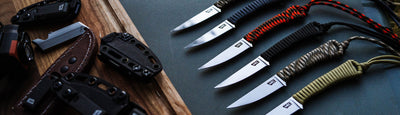
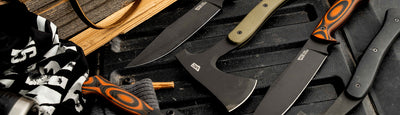









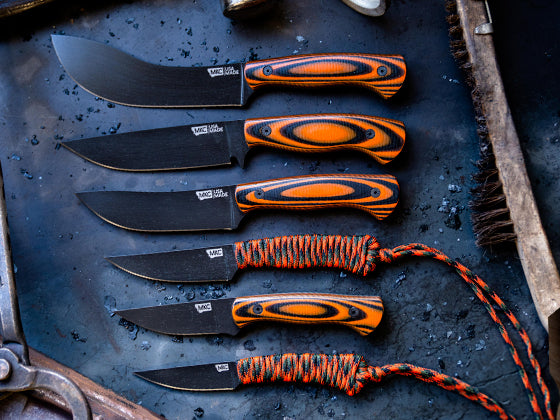
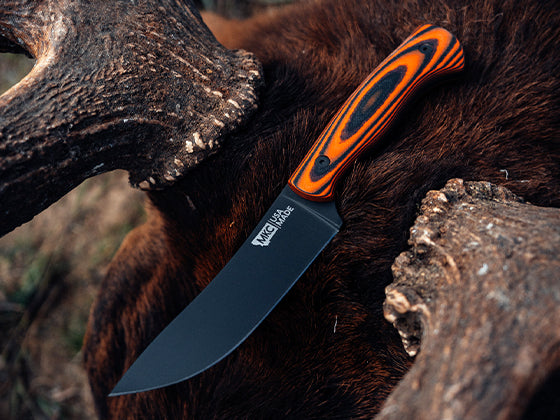
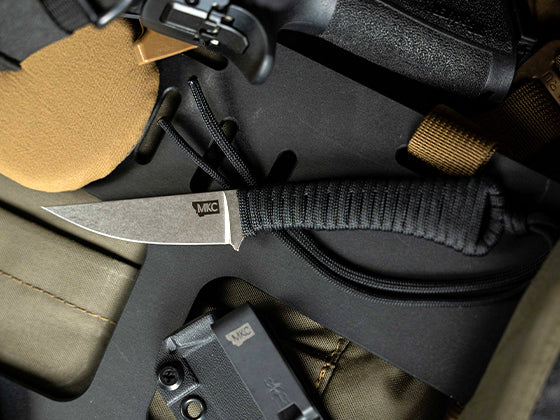


Whether you’re breaking down a deer roast or slicing home-grown vegetables for dinner, the types of knives in your kitchen determine how efficiently you work and how much you enjoy the process. Understanding different types of knives helps you choose the right tool for every task.
We’ve spent years designing blades for the field, and that same attention to purpose and function goes into every kitchen knife we make at Montana Knife Company.
This guide covers the types of knives you’ll actually use, when to reach for each one, and how to build a collection that works as hard as you do.

The Workhorse: Chef’s Knife
With a curved blade ranging from 6–10 inches, the chef’s knife handles chopping, slicing, dicing, and mincing with a rocking motion that lets you breeze through prep.
Most home cooks do well with an 8-inch blade. It’s long enough to slice through a butternut squash, but maneuverable enough for mincing garlic and herbs.
Our Bighorn Chef Knife features a 7 3/4-inch MagnaCut blade with a PVD finish. At 8.33 ounces, it’s hefty enough to power through meat and vegetables alike, but still nimble enough for fine work. Our Shedhorn Chef and Meat Church collaboration knives are equally capable, and they’re the perfect type of kitchen knife for chefs who prefer a lighter touch.
The Precision Tool: Paring Knife
When tasks get small and detailed, a paring knife takes over. Its 3–4-inch blade handles tasks that would be clumsy with a chef’s knife, such as hulling strawberries, deveining shrimp, removing potato eyes, and peeling fruit.
A paring knife is your detail brush. The short blade gives you fingertip control.
Our Cutbank Paring Knife brings MagnaCut steel to this category with a 4 1/8-inch blade. At just 2.57 ounces, you barely notice it in your hand.
The Middle Ground: Petty Knife
Falling between chef’s knives and paring knives, the petty knife handles medium-sized tasks: slicing sandwiches, cutting citrus, and trimming vegetables.
A 4–7-inch blade works when a chef’s knife feels too big, but a paring knife seems too small. This type of kitchen knife is your problem-solver for jobs that don’t fit neatly into other categories.
The Little Bighorn Petty is MKC’s culinary utility knife. Use it for boning, slicing, cutting, and more. It has all the versatility of a good chef’s knife, but with slightly more control and maneuverability.
The Meat Specialist: Boning Knife
Anyone who processes their own game already knows a good boning knife’s value. In the kitchen, it separates meat from bone, removes silver skin, and breaks down poultry with accuracy.
This type of kitchen knife is narrow, slightly curved, and typically 5–7 inches long. Some have flexible blades that hug bone contours; others stay stiff for more aggressive work.
Our Boning Butcher from the Bearded Butchers collaboration uses AEB-L steel and a 5 7/8-inch blade. The 0.09-inch thickness provides the flex you need to follow curved bones without wasting meat.
The Fish Expert: Fillet Knife
If you fish or cook whole fish regularly, a good fillet knife is a requirement, not a luxury. The thin, flexible blade (typically 6–9 inches) follows the contours of fish bones to separate flesh cleanly.
Extra flexibility sets this type of kitchen knife apart from a boning knife. Where boning knives maintain some rigidity, fillet knives bend to skate over fragile fish bones instead of crushing them.
The Flathead Fillet has a 7 1/2-inch MagnaCut blade that’s just 0.097 inches thick for serious flex. At 4.45 ounces, it won’t fatigue your hand after a long day on the water.
The Heavy Hitter: Cleaver
Cleavers intimidate people who don’t understand them. That wide, heavy blade isn’t meant for finesse. It’s made to power through tasks that would damage other knives: splitting poultry, cracking through bones, and breaking down large cuts.
When it comes to this type of kitchen knife, the weight does most of the work. You lift it and let gravity help with the cut. Some cooks also use the flat side to crush garlic or transfer chopped ingredients to a pan.
The Cattlemen Cleaver 2.0 weighs in at 11.89 ounces with a 6 3/4-inch MagnaCut blade. The 0.17-inch thickness handles whatever you throw at it.
The Butcher’s Choice: Breaking Knife
When you’re processing larger cuts of meat, whether from your hunt or from the butcher, you need a type of kitchen knife built for the job. A breaking knife has a long, curved blade suitable for separating these cuts.
Enter the Breaking Butcher. At 7 3/4 inches long and with an AEB-L steel blade, it holds its edge through extended breakdowns.
The Sawtooth Slicer from our Rinella collaboration also makes a great breaking knife. Its thin profile makes clean work of tough foods, and the ultra-precise tip gives you control for delicate tasks.
The Bread Solution: Serrated Knife
Crusty bread destroys regular types of kitchen knives. The hard crust slides under a straight edge, compressing the soft interior. A serrated blade grabs and tears through crust without crushing what is underneath.
The same principle works for tomatoes, citrus, and angel food cake. Those serrations grip slippery or delicate surfaces that would resist a smooth edge.
The blade length on serrated knives typically runs 8–10 inches to handle full loaves in single strokes.
Japanese Kitchen Knives: A Different Philosophy
When exploring the types of knives professional kitchens rely on, Japanese blades stand apart. Japanese knife making developed alongside a cuisine that prizes precise cuts and delicate presentation.
While Western knives tend toward versatility and durability, Japanese blades are optimized for specific tasks and razor-sharp performance.
Santoku
The santoku knife, meaning “three virtues,” handles slicing, dicing, and mincing with ease. Its flatter profile compared to a Western chef’s knife encourages an up-and-down chopping motion rather than rocking.
The Smith River Santoku brings this Japanese style to our lineup with a 6 3/4-inch MagnaCut blade. The PVD finish resists corrosion, and the G10 handle won’t absorb moisture.
Nakiri
The nakiri is a vegetable specialist. Its rectangular blade with a flat edge makes full contact with the cutting board, producing clean cuts through onions, carrots, and leafy greens with a straight downward motion.
If vegetables make up most of your cooking, a nakiri will speed up your prep work.
Deba
Traditional Japanese fish butchery relies on the deba. Its thick spine and single-bevel edge break down whole fish, cut through bones, and separate fillets.
This type of kitchen knife is basically the Japanese version of a boning knife, but heavier and built for fish.
Yanagiba
Sashimi requires perfect slices. The yanagiba, a long, single-bevel blade (often 10–12 inches), creates those cuts in a single pull stroke. The blade never saws back and forth. One smooth motion produces clean surfaces that affect both texture and presentation.
Usuba
Where the nakiri serves home cooks, the usuba serves professionals. Its single-bevel edge creates paper-thin vegetable cuts and allows for decorative techniques common in high-end Japanese cuisine. It takes more skill to use, but the cuts speak for themselves.
Western vs. Japanese: Choosing Your Style
The difference between Western and Japanese types of knives comes down to philosophy as much as function.
|
Aspect |
Western Style |
Japanese Style |
|
Steel hardness |
54–58 HRC (softer, more flexible) |
60–67 HRC (harder, holds edge longer) |
|
Edge angle |
20–25 degrees per side |
10–15 degrees per side |
|
Blade thickness |
Thicker, more durable |
Thinner, more precise |
|
Weight |
Heavier, uses momentum |
Lighter, emphasizes control |
|
Maintenance |
Less frequent sharpening |
More frequent honing |
|
Bevels |
Double-bevel (both sides) |
Often single-bevel |
Western knives forgive abuse. You can rock them, twist them, and push through tough ingredients without worrying about chipping. Japanese knives reward good technique with cleaner cuts and less effort.
At MKC, we use MagnaCut steel in most of our kitchen knives. It combines stainless steel’s corrosion resistance with edge retention that rivals traditional Japanese steels. The blade performs like a Japanese knife, but can take the abuse of a Western one.
Which Type of Kitchen Knife for Which Task?
Once you understand the different types of kitchen knives available to you, matching them to specific jobs gets easier.
|
Task |
Best Knife |
Backup Option |
|
Chopping vegetables |
Chef’s knife or nakiri |
Santoku |
|
Mincing garlic/herbs |
Chef’s knife |
Santoku |
|
Slicing meat |
Breaking knife |
Chef’s knife |
|
Breaking down poultry |
Boning knife or cleaver |
Chef’s knife |
|
Filleting fish |
Fillet knife |
Boning knife |
|
Peeling fruit |
Paring knife |
Petty knife |
|
Slicing bread |
Serrated knife |
No good substitute |
|
Cutting tomatoes |
Serrated or paring knife |
Petty knife |
|
Crushing garlic |
Cleaver |
Chef’s knife (flat side) |
|
Detailed cuts |
Paring knife |
Petty knife |
|
Sashimi/raw fish |
Yanagiba |
Very sharp fillet knife |
Care and Maintenance for Kitchen Knives
All types of knives require proper care, but kitchen blades face unique challenges. Moisture, food acids, and frequent use can cause the knife to deteriorate quickly.
Cleaning: Wash your kitchen knives by hand immediately after use. The dishwasher is off limits. High heat, harsh detergents, and jostling against other items damage edges and handles. Instead, wash quickly with soap and water, then dry with a towel.
Storage: Edge-on-edge contact destroys knife sharpness. Use a magnetic strip, knife block, or blade guards instead. Never leave knives loose in a drawer.
Cutting surfaces: Hard surfaces like glass, granite, and ceramic chip and dull edges. Use wood or plastic cutting boards to preserve a sharp cutting edge.
Honing: Run your blade along a honing steel before each use. This realigns the edge without removing material. It takes 30 seconds and keeps knives performing between sharpenings.
Sharpening: When honing no longer restores cutting ability, it’s time to sharpen. Whetstones give you the most control. Pull-through sharpeners work in a pinch, but remove more material. Sharpen every few months, depending on how heavy your usage is.
Protection: MKC’s food-safe Blade Wax works just as well on kitchen knives as it does on field knives. A thin coat after cleaning prevents moisture damage and keeps the blade looking sharp.
Building Your Kitchen Knife Collection
With so many types of kitchen knives to choose from, where do you start? If you’re building from scratch, here’s the order we recommend:
- Chef’s knife (the foundation for 90% of tasks)
- Paring knife (for detail work)
- Petty knife (for what the chef’s knife can’t do)
- Serrated bread knife (nothing else does this job)
- Boning or fillet knife (especially if you hunt or fish)
From there, add based on what you cook. If you process a lot of meat, get a cleaver. A santoku or nakiri makes sense for vegetable-heavy cooking. And if you’re regularly working with whole fish, a dedicated fillet knife pays for itself.
Quality beats quantity. Three excellent knives outperform ten mediocre ones. Invest in blades that feel right in your hand, hold their edge, and make you want to cook.
Frequently Asked Questions About Types of Knives
What’s the most versatile kitchen knife?
Among all the types of kitchen knives available, the chef’s knife handles more tasks than any other blade. If you could only own one kitchen knife, make it a quality chef’s knife in the 8-inch range.
Do I need both a chef’s knife and a santoku?
Not necessarily, though you may find it useful. They serve similar purposes with different styles.
Try both if you can, and see which motion feels more natural to you. Many cooks prefer one over the other.
How often should I sharpen my kitchen knives?
Sharpen when honing no longer restores your kitchen knife’s cutting ability. For home cooks, that’s usually every three to six months. Professional use demands more frequent maintenance.
Are expensive knives worth it?
A well-made knife holds its edge longer, feels better in your hand, and lasts for generations. You’re paying for years of service with an expensive knife, and when compared to an inexpensive one that breaks a few years in, that cost can be worth it.
What steel is best for kitchen knives?
It depends on your priorities. Carbon steel gives you the sharpest edge, but requires more care. Stainless resists corrosion, but may not get as sharp. MagnaCut splits the difference well.
The Right Type of Kitchen Knife for the Work
Every knife we make at Montana Knife Company does a specific job. We don’t add features for show or follow trends that don’t improve function. That approach started in the field and carries into the kitchen.
Your knives need to work as hard as you do. Build your collection around what you actually cook and maintain your blades properly, and those types of kitchen knives will serve you for decades.
Explore our full culinary knife collection to find blades built with the same care we put into our field knives.
by Josh Smith, Master Bladesmith and Founder of Montana Knife Company