









A survival knife isn’t a hunting knife with a bigger blade. It’s a different tool designed for a different mindset, and picking the wrong one can leave you frustrated, underprepared, or both.
At Montana Knife Company, we’ve spent serious time studying what separates a real survival knife from the blades that get marketed as one. The differences aren’t cosmetic. They’re rooted in purpose, geometry, and the scenarios each knife is built to handle.
This guide breaks down what to look for in a survival knife, how it compares to bushcraft blades, and which features actually matter when you’re choosing one.

Survival Knives and Bushcraft Knives Are Polar Opposites
Most people assume survival knives and bushcraft knives are the same, but they sit on opposite ends of the fixed blade spectrum.
Bushcraft is about going into the wilderness with the intention of living there, with no panic and no rush to leave. You build shelters, carve spoons, start fires with a ferro rod, and improve your camp over days or weeks.
It’s proactive, recreational, and rooted in self-reliance for its own sake. European knife makers like Mora and Fallkniven, Ray Mears documentaries, and the contestants on Alone who thrive in the wilderness all embody this philosophy.
A survival knife serves the opposite purpose. It’s the tool you reach for when the plan falls apart. You need to baton through dense wood in a hurry, dig a fire hole, pry open a stuck latch, or cut yourself free from cordage.
The survival mindset is reactive, efficient, and focused on getting out. Military SERE (Survival, Evasion, Resistance, and Escape) training captures this perfectly: concealment, speed, mission completion, and extraction.
The people who thrive on Alone didn’t train to survive a mission and get out. They trained to go in and stay. Once the military-trained contestants get past their mission mindset, they often hit a wall. The people who are used to being out there, improving their camp, and making themselves comfortable with very little are the ones who last.

Survival Knife Blade Geometry: Scandi Grinds vs. Saber Grinds
Blade geometry is the biggest technical differentiator between bushcraft and survival knives.
Scandi Grinds: Great for Bushcraft, Wrong for a Survival Knife
A true bushcraft knife runs a Scandi grind, where the main bevel goes straight to the cutting edge without a secondary bevel. It’s a simple V-shape, like a chisel. That simplicity is the whole point.
A Scandi grind acts as its own sharpening guide. You lay the bevel flat on a stone, swipe a few times, and you’re back to sharp. Even someone with zero sharpening experience can maintain one in the field.
For bushcrafters who plan to spend days in the woods carving, processing firewood, and prepping game, that ease of maintenance is a huge deal.
Scandi grinds punch above their weight. Even thin, lightweight knives with this geometry can handle heavy batoning and splitting tasks.
Please note: Montana Knife Company does not currently offer knives with a true Scandi grind. Any discussion of Scandi grinds in this guide is for educational and comparison purposes only.
Why Survival Knives Run Saber or Flat Grinds
A survival knife typically runs a saber grind or flat grind with a secondary bevel. This geometry is thinner behind the edge than a Scandi, which gives it more cutting ability when the blade goes dull. In a survival scenario, you may not have time or the tools to do a field sharpening session.
The saber grind keeps spine strength along the top of the blade for batoning and prying, but the thinner geometry below the grind line still cuts well even after hard use. If the edge dulls from digging or hitting dirt, you’ve still got a blade that can cut rope or slice through material. That margin of forgiveness matters when you can’t stop and break out a sharpening stone.
You’d never put serrations on a bushcraft knife. But military and survival blades frequently include them for a reason: when your blade is trashed from hard use, serrations still cut rope. It’s a failsafe, ugly as it may be.
Five Features That Separate a Survival Knife From a Shelf Decoration
1. Full Tang Construction Keeps Your Survival Knife in One Piece
A full tang means the steel runs the entire length of the handle. This is non-negotiable for a survival knife.
Rat-tail tangs and partial tangs snap under the stress of batoning, prying, and hard impacts. Full tang construction gives you a blade that can take punishment all day without structural failure.
Every knife in the MKC lineup uses full tang construction. It’s a feature we won’t compromise on, and it’s worth verifying regardless of which brand you choose.
2. The Right Survival Knife Blade Length: Four to Seven Inches
Bushcraft blades typically run three to five inches for better tip control during carving and detail work. A survival knife needs more length.
Four to seven inches gives you the reach and force multiplication for batoning through thick wood, chopping small limbs, and prying. Go much longer than seven inches, and you start losing control for finer tasks. Go shorter than four, and you sacrifice the power you need when brute force is the only option.
3. Thick Blade Stock Gives a Survival Knife Prying Power
Blade thickness determines how much lateral stress your knife can absorb. Bushcraft knives can get away with thinner stock since the work is controlled and precise. A survival knife needs a thicker spine, typically .140″ or above, to handle the twisting, prying, and hard impacts that come with emergency use.
The thicker the blade stock, the more confident you can be jamming the tip into wood and twisting, batoning through hardwood rounds, or using the knife as a makeshift pry bar. The tradeoff is weight, and that’s a calculation every buyer needs to make.
4. A Flat-Sided Handle Locks Your Survival Knife in Place
Handle shape gets overlooked, but it’s a big differentiator.
Bushcraft knife handles are typically round and smooth, letting you rotate the blade freely for different carving grips. They often skip the finger guard entirely, partly for legal reasons in certain countries and partly as a cultural tradition in the European bushcraft community.
A survival knife needs the opposite approach. Flat sides on the handle prevent the blade from rolling in your grip during hard strikes or stabbing motions.
A guard keeps your hand from riding up onto the blade when you’re cold, wet, and operating on adrenaline. A thumb ramp gives you control in a reverse grip.
Modern tactical knife designers favor flat handles with positive indexing. You always know how the edge is oriented without looking.
In a bushcraft context, that restriction gets in the way. In a survival scenario, it could save your hand.
5. A Secure Sheath Keeps Your Survival Knife Where You Need It
Bushcraft knife sheaths tend to be loose-fitting with a dangler loop so the sheath can rotate and stay out of the way when you’re sitting on a stump carving. The priority is accessibility and comfort during long sessions.
A survival knife sheath needs to be “jump rated,” meaning your knife stays put even during high-impact movement like falling, running, or scrambling over terrain. Adjustable retention screws, secondary locks, and compatibility with MOLLE webbing or belt loops are standard. You don’t want your knife to fall out of its sheath when you need it most.
Steel Selection for a Survival Knife
Both bushcraft and survival knives benefit from tough steel over high edge retention. A blade that chips or snaps under stress is worse than a blade that goes dull.
52100 ball bearing steel is a classic survival choice. It’s a high-carbon spring steel that absorbs impacts without breaking. MKC uses cryogenically treated 52100 on several blades in our lineup, and it strikes the right balance of toughness, edge retention, and ease of resharpening.
MagnaCut stainless steel is MKC’s go-to for blades that need corrosion resistance in addition to toughness. It holds an edge longer than most stainless steels and resharpens more easily than other premium options.
For a survival knife that may sit unused for months before you need it, stainless steel’s low-maintenance properties matter. You want to grab your blade and have it ready without worrying about rust from sitting in a pack.
Avoid steels optimized purely for edge retention at the expense of toughness. A survival knife that chips when it hits a nail or breaks while prying has failed at its primary job.
Survival Knife vs. Bushcraft Knife: A Side-by-Side Comparison
|
Feature |
Survival Knife |
Bushcraft Knife |
|
Mindset |
Reactive: get out alive |
Proactive: go in and thrive |
|
Blade Grind |
Saber or flat grind |
Scandi grind |
|
Blade Length |
4–7 inches |
3–5 inches |
|
Blade Thickness |
.140″+ |
.100–.120″ |
|
Handle Shape |
Flat sides with guard |
Round, smooth, no guard |
|
Sheath |
Jump-rated, secure retention |
Loose fit, dangler loop |
|
Primary Tasks |
Batoning, prying, chopping, digging |
Carving, fire prep, shelter building |
|
Edge Maintenance |
Field-serviceable, forgiving when dull |
Easy Scandi resharpening on any flat stone |
|
Weight Priority |
Heavier for durability |
Lighter for all-day carry |
|
Concealment |
Low-vis coatings, no shine |
Visibility doesn’t matter |
MKC Survival Knives Built for Real Scenarios
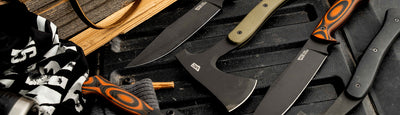
We build blades across the full spectrum, from ultralight hunting knives to purpose-built survival tools. Here are the MKC knives that lean hardest into survival readiness.

The Redacted: A Survival Knife Built for SERE Operations
The Redacted is our most specialized tactical survival blade, originally inspired by military SERE training. It’s built for the kind of abuse that would destroy most knives.
The 4 7/8″ drop point blade features a high saber grind and a reinforced tip designed to handle the twist-and-hammer kindling technique that SERE instructors use. The blade stock sits at .170″ thick, and the Cerakote-coated MagnaCut steel eliminates glare and resists corrosion. A full-sized G10 handle with flat sides and tactical texture provides positive indexing in any grip, and the integrated steel pommel doubles as a hammering surface for driving stakes or pounding the spine during batoning.
Redacted Specs:
- Blade Steel: MagnaCut Stainless Steel
- Blade Length: 4 7/8″
- Overall Length: 10 1/4″
- Blade Thickness: .170″
- Weight: 7.75 oz
- Handle: G10
- Finish: Cerakote
The Fieldcraft Survival Knife: The EDC Survival Blade
The Fieldcraft Survival Knife was designed by Master Bladesmith Josh Smith and the experts at Fieldcraft Survival. Over a year of R&D went into this blade, and the goal was clear: create a survival knife small enough to carry every day, but capable enough to handle real work.
At 3 1/2″ of blade length and 3.78 oz, it disappears in your pocket or clips inside a waistband. The full flat grind with a secondary bevel makes it easy to maintain in the field, and the MagnaCut steel resists corrosion during long stretches between uses. The sheath features a fabric-grabbing metal pocket clip with a retainer tab that secures to pants, shorts, leggings, or MOLLE webbing.
Fieldcraft Survival Knife Specs:
- Blade Steel: MagnaCut Stainless Steel
- Blade Length: 3 1/2″
- Overall Length: 8 3/8″
- Blade Thickness: .120″
- Weight: 3.78 oz
- Handle: G10
- Finish: Stonewash
The MKC Chopper: The Hardest-Hitting Survival Knife We Make
The MKC Chopper is our most aggressive survival blade. It’s built for chopping through wood, clearing brush, and processing firewood with one-tool efficiency.
The 9 3/8″ recurved blade pushes weight forward for devastating chopping power, and the quarter-inch-thick 52100 carbon steel spine takes impacts that would snap thinner blades. The G10 handle features strategic thickness changes that create natural grip points, chunky where you need power and thinner where comfort matters. Every Chopper ships with a premium leather sheath with double belt loops for vertical or horizontal carry.
MKC Chopper Specs:
- Blade Steel: 52100 Ball Bearing Steel
- Blade Length: 9 3/8″
- Overall Length: 15″
- Blade Thickness: .20″
- Weight: 15.61 oz
- Handle: G10
- Finish: PVD
Every MKC Survival Knife Is Backed by the MKC Generations® Promise
Every MKC blade comes backed by our MKC Generations® promise. We’ll clean, sharpen, repair, and reshape your knife free of charge for the life of the blade.
This isn’t tied to the original buyer. The promise follows the knife itself, so if it changes hands down the line, the new owner gets the same service.
Pick the Survival Knife That Matches Your Scenario
The best survival knife is the one that matches how you’ll actually use it. Carry a Fieldcraft if you want survival-capable steel on your hip every day. Grab a Redacted if you’re gearing up for backcountry trips where weight matters less than capability.
The Chopper is the pick when camp-processing firewood and brush clearing are at the top of your list. Don’t buy a bushcraft knife and expect it to perform like a survival blade, and don’t buy a survival knife expecting it to carve delicate spoons. The two are built for different jobs by design.
Frequently Asked Questions About Survival Knives
What is the best blade length for a survival knife?
Most survival knives perform best with a blade between four and seven inches. That range gives you enough reach to baton through thick wood and chop small limbs, but enough control for finer tasks like cutting rope or prepping kindling. Blades shorter than four inches lack the force multiplication for heavy camp work, and blades longer than seven inches get unwieldy for precise cuts.
Can you use a survival knife for hunting?
A survival knife can handle field dressing and game processing in a pinch, but it’s not optimized for it. Hunting knives run thinner grinds and finer tips for precision cuts against hide and connective tissue. A survival knife’s thicker blade stock and aggressive geometry are built for batoning, prying, and chopping, not for the controlled strokes you want when caping an animal.
What steel is best for a survival knife?
Tough steels that resist chipping and snapping under impact are the priority for a survival knife. MKC uses 52100 ball bearing steel for blades like the Chopper, and MagnaCut stainless steel for the Redacted and Fieldcraft. Both options absorb hard use without failing, and both can be resharpened in the field without specialized equipment.
What is the difference between a survival knife and a bushcraft knife?
A survival knife is built to get you out of a bad situation as fast as possible, with a focus on durability, strength, and multi-purpose abuse tolerance. A bushcraft knife is designed for going into the woods and staying comfortably, with a focus on carving control, easy resharpening, and extended campcraft.
The two differ in blade grind, handle shape, sheath style, and overall design philosophy. Our survival knife comparison chart above breaks down the full list of differences.
Do you need a full tang on a survival knife?
Full tang construction is the only option worth trusting in a survival knife. Partial tangs and rat-tail tangs snap under the stress of batoning, prying, and hard lateral impacts. Every MKC blade runs a full tang, and it’s one of the first specs to check on any survival knife regardless of brand.
How do you sharpen a survival knife in the field?
A survival knife with a saber or flat grind can be touched up on a pocket stone, a flat river rock, or even the unglazed bottom of a ceramic mug. Lay the secondary bevel against the abrasive surface and maintain a consistent angle through 10–15 strokes per side.
MagnaCut and 52100 steels both respond well to field sharpening without specialized tools. MKC backs every blade with our MKC Generations® promise for free professional resharpening at any point in the knife’s life.
by Josh Smith, Master Bladesmith and Founder of Montana Knife Company