
















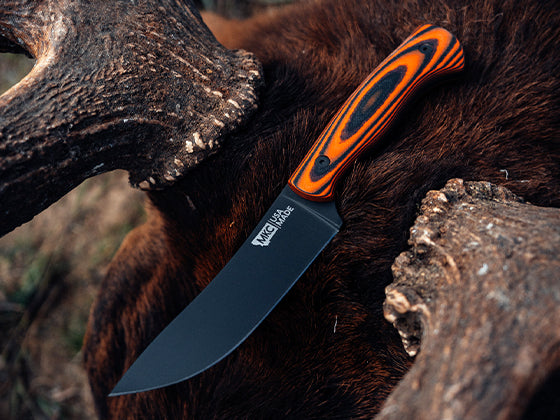
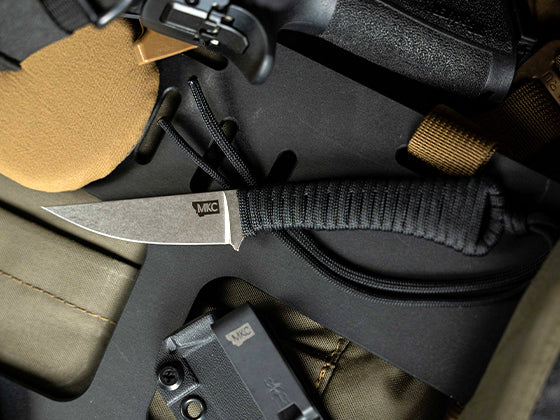


Most people pick their chef’s knife off a store shelf without a second thought. They get a gift card to Williams Sonoma, grab whatever fits the budget, and call it a day.
That knife winds up in a drawer with a dull edge and a steel type nobody can name.
Knowing how to choose a chef’s knife starts with asking a few honest questions about how you actually cook, what other knives you own, and what kind of performance you expect from the blade. We’ll walk through each of those factors below.

What to Know Before Choosing a Chef’s Knife
Before you look at blade length or steel type, take stock of your kitchen. Think about the knives you already own and the one you reach for most.
If your chef’s knife is your only real kitchen knife, it needs to cover a lot of ground. That’ll affect every decision you make, from blade length to profile. If you’ve got a solid Santoku or paring knife for smaller tasks, your chef’s knife can be more specialized.
The thickness of a chef’s knife’s blade matters more than most people realize. A thin culinary knife slices through food with less effort, even when the edge isn’t perfectly sharp. Compare that to a thicker EDC-style blade, which relies almost entirely on a sharp edge to cut. A chef’s knife’s thin stock does a lot of the work for you.
How Chef’s Knife Blade Length Affects Your Cooking
Blade length is one of the first features anyone considers when shopping for a chef’s knife, and most people get it wrong. The tendency is to go big and grab the 10-inch knife off the rack, but that knife usually sits in the drawer for 11 months out of the year.
Your most-used chef’s knife is almost always found in the middle of the set. We hear this from our team, from knife owners, and from professional cooks. The eight-inch and six-inch blades get the daily reps. The 10-inch comes out for brisket or Thanksgiving turkey, and that’s about it.
Match the knife to what you’re cutting. If you’re slicing chicken for a salad, you don’t need a 10-inch blade.
If you have smaller hands, a shorter knife gives you better control and lets you work without thinking about the tool. You want the knife to feel like an extension of your hand, not a piece of equipment you’re managing.

Choose a Chef’s Knife Blade Profile for How You Cut
Blade profile is where a lot of people get tripped up, because the knife that looks best on the counter isn’t always the knife that feels best on the cutting board.
Western chef knives, especially German-style profiles, have a pronounced curved belly. That curve favors a rocking motion where you keep the tip on the board and pivot the blade through your cuts.
French and Japanese profiles run flatter. You get more contact with the cutting surface for long, straight slices.
If you haven’t practiced a rocker-style technique, a curved belly can feel awkward. You’ll fight the knife rather than work with it.
A flatter chef’s knife edge gives you great control. The Santoku profile is a perfect example: a gentle curve, a wider blade for scooping, and no sharp tip to worry about.
Put function ahead of aesthetics. A straight Japanese handle or a dramatic curve might look great on a magnetic strip, but comfort and cutting performance matter more when you’re 20 minutes into dinner prep.
Pick a Chef’s Knife Handle That Fits Your Kitchen
If you put your knives in the dishwasher (we won’t judge, but we want to), don’t buy a knife with a wooden handle. Hot water and detergent dry out wood, weaken the bond between the handle and the blade, and shorten the knife’s lifespan. G10, a high-strength fiberglass laminate, holds up against moisture, temperature swings, and daily abuse without absorbing odors or breaking down.
Ergonomics matter, too. Look for a chef’s knife handle with zero hot spots and enough clearance between your knuckles and the cutting board. If a chef’s knife causes hand fatigue after five minutes of chopping, the handle isn’t right for you, no matter how nice the blade is.
Why Your Chef’s Knife Steel Matters More Than the Brand Name
Pick up a mid-range chef’s knife from almost any big retail brand and look at the specs. The steel will be listed as “stainless steel,” and that’s it. No specific alloy, no hardness rating, no performance data. It’s mystery meat.
That mystery steel will come reasonably sharp out of the box. It’ll cut food. But within a few meals, the edge will start to roll, and you’ll press harder, sawing instead of slicing. You won’t notice how dull it’s gotten until you pick up a properly sharp knife and realize what you’ve been missing.
A named, premium steel holds its edge longer. MagnaCut, the steel we use in our MKC chef’s knives, is a cryogenically heat-treated stainless steel with high toughness, edge retention, and corrosion resistance. It stays sharp through multiple meals without needing a touch-up, and when you do need to resharpen it, even a novice can bring it back to factory condition.
What to Expect at Every Chef’s Knife Price Point
Chef’s knife prices are all over the map. The differences come down to steel, construction, and how long the knife lasts.
$50 to $100: Thin blades in basic stainless steel. They come sharp enough, but they don’t stay that way long. When the edge goes, it’s often cheaper to replace the knife than to have it professionally sharpened. These make great beater knives for camp kits or as backups.
$100 to $300: Better steel, better heat treatment, and better handle ergonomics. You’ll notice the edge lasts longer and the handle feels more comfortable during longer prep sessions. This is where most people start to appreciate what a good knife feels like.
$300 and up: This is purpose-driven territory. You’re paying for a specific steel alloy, full tang construction, and a knife designed with a specific cutting philosophy in mind. At this level, expect a warranty and maintenance program, such as MKC Generations®, that covers free resharpening and restoration for the knife’s life.
A premium chef’s knife isn’t a purchase you make once and forget about. It’s a tool you maintain, and the right company will help you keep it performing year after year. For instance, the MKC Generations® warranty follows the knife itself, not the original owner. If you pass it down, the warranty goes with it.
Keep Your Chef’s Knife Performing at Its Best
A sharp knife is a safe knife. A dull knife forces you to push harder, and that’s when accidents happen.
Hone your blade once a week with a ceramic honing rod. Honing realigns the micro-serrations on the edge without removing material. It’s quick, and it keeps the knife precise between sharpening sessions.
Avoid diamond honing rods, which can be too aggressive and shear off the edge rather than realign it.
Sharpen once a month with a whetstone. A combination stone with 1,000 grit on one side and 6,000 grit on the other gives you two tools in one. Work the 1,000-grit side to reset the edge, then flip to the 6,000 side to refine it.
Skip the pull-through sharpeners you see at big-box stores; they wear out fast and don’t perform as well.
Between sharpening sessions, treat your knife well. Hand wash with warm, soapy water (no dishwasher). Store it sheathed, on a magnetic strip, or in a knife block, not loose in a drawer where the edge bangs around.
Cut on wood or plastic boards, not glass, stone, or ceramic. Condition the blade with a food-safe blade wax to protect against moisture.
Take care of your chef’s knife, and it’ll take care of you for decades.
by Josh Smith, Master Bladesmith and Founder of Montana Knife Company