





















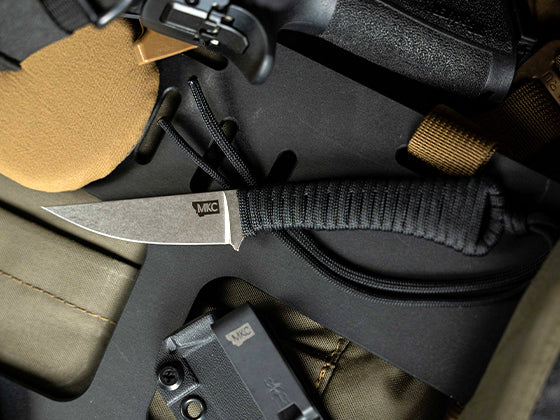










MagnaCut steel changed what we thought we knew about knife steel.
For years, knife makers and enthusiasts accepted a frustrating trade-off: You could have a tough blade, excellent edge retention, or corrosion resistance, but never all three. Then metallurgist Dr. Larrin Thomas did what no one thought possible: He designed a knife steel that delivers on all fronts.
At Montana Knife Company, we’ve adopted MagnaCut for many of our blades. After all, MKC knives aren’t about compromise. We give hunters and outdoorsmen blades that perform when it matters.
We sat down with Dr. Thomas himself to dig into the science, the story, and the practical details that make MagnaCut steel worth understanding.
What Is CPM MagnaCut Steel?
CPM MagnaCut is a powder metallurgy stainless steel developed for knives. Unlike most blade steels derived from industrial applications, MagnaCut was engineered from the ground up to address weaknesses in other knife steels.
MagnaCut steel combines high toughness with wear resistance and genuine stainless performance, a balance no other steel quite achieves. That might sound like marketing speak, but the metallurgy backs it up.
How Crucible Developed MagnaCut
CPM MagnaCut’s origins started with trips to knife shows. Dr. Thomas grew up in the knife world, as his father, Devin Thomas, was known for his work with Damascus steel.
“These trips provided me with a lot of interaction with knife makers,” Thomas explains. “They would say they had secret steel, better steel, and special heat treatments that led to better steel properties than other knife makers. Intrigued, I started studying how steel was made.”
That curiosity led to a PhD in metallurgical engineering and work as a steel metallurgist. Eventually, Thomas spotted an anomaly when plotting toughness versus wear resistance for existing stainless steels: a large gap in the chart where a better steel could exist.
He contacted Crucible Steel with his idea. They had questions. Lots of them.
Thomas provided experimental data and predictive models, but as he puts it, “You never really know if a new development will work until you try it.”
MagnaCut came out of its first heat working exactly as predicted. The corrosion resistance turned out even better than he’d expected.

CPM MagnaCut Composition and Metallurgy
To understand what makes MagnaCut steel special, we have to look at the chemistry. Here’s the composition.
|
Element |
Percentage |
Function |
|
Carbon (C) |
1.15% |
Increases hardness and enables carbide formation |
|
Chromium (Cr) |
10.7% |
Gives corrosion resistance |
|
Vanadium (V) |
4.0% |
Forms hard, wear-resistant carbides |
|
Niobium (Nb) |
2.0% |
Creates additional hard carbides, refines grain structure |
|
Molybdenum (Mo) |
2.0% |
Improves strength and corrosion resistance |
|
Nitrogen (N) |
0.20% |
Enhances corrosion resistance without large carbides |
The key innovation is in the chromium. Traditional stainless knife steels contain 14–20% chromium, but much of that chromium gets locked up in chromium carbides that can’t actually fight corrosion. Thomas reduced the chromium to around 11% and balanced the composition so that all of it stays “in solution” to form a protective chromium oxide layer.
“My idea was to reduce the chromium content down to the actual chromium we needed in solution,” Thomas told us. “About 11%, right in the middle of that 9–13% effective range, and then adjust the rest of the composition so we didn’t have extra chromium carbides after heat treatment.”
Instead of chromium carbides, MagnaCut uses vanadium and niobium carbides. These are harder than chromium carbides, so you get better wear resistance with fewer, smaller carbide particles. The result is a steel that behaves like the best non-stainless tool steels while maintaining the corrosion resistance of stainless.
MagnaCut HRC Hardness: What the Numbers Mean
MagnaCut can be heat-treated anywhere from 59 to 64 HRC (Rockwell C hardness). This flexibility lets knife makers dial in the exact balance of properties for different applications.
Here’s what that hardness range means in practice:
|
Hardness Range |
Characteristics |
Best For |
|
59–60 HRC |
Maximum toughness, easier sharpening |
Heavy-use fixed blades, batoning |
|
61–62 HRC |
Balanced performance |
General hunting, all-around use |
|
63–64 HRC |
Maximum edge retention |
Precision cutting, folders, kitchen use |
“Anywhere between 59 and 64 on the Rockwell hardness scale can work great,” Thomas explains. “I know some out there give specific hardness targets they think are ideal or claim a knife is no good below a certain hardness. But I feel that ignores the balance you get at different hardness points.”
Most production MagnaCut knives, including ours at Montana Knife Company, run in the 61–63 HRC range. This gives it excellent edge holding capability while maintaining the toughness that makes MagnaCut steel special.
MagnaCut Performance: Edge Retention, Toughness, and Corrosion Resistance
Edge Retention
MagnaCut steel’s edge retention falls between S35VN and S45VN in standardized CATRA testing. That might not sound revolutionary, but those tests only measure abrasion resistance. Real-world edge retention depends on toughness, too.
A blade that chips or rolls under pressure loses its edge regardless of how wear-resistant it is. MagnaCut’s fine carbide structure means the edge degrades gradually through wear rather than suddenly failing. In practical use, many users find MagnaCut holds a working edge longer than steels that score higher on pure abrasion tests.
Toughness
This is where MagnaCut really separates itself from other stainless steels. The absence of large chromium carbides and the fine, evenly distributed vanadium and niobium carbides give MagnaCut toughness comparable to that of non-stainless tool steels like CPM-4V.
In Charpy impact testing at 62.5 HRC, MagnaCut steel delivers approximately 38 ft-lbs of toughness. For context, that’s roughly 40% tougher than S35VN at similar hardness and competitive with dedicated “tough” steels.
What does this mean in practice? Thin edges won’t chip on bone. Fixed blades can handle batoning. You, the hunter, have the confidence to actually use your knife without babying it.
Corrosion Resistance
Despite having less chromium than most stainless steels, MagnaCut steel’s corrosion resistance is excellent, approaching specialized marine steels like LC200N.
The reason goes back to that chromium carbide elimination. In traditional stainless steels, the areas around chromium carbides have reduced free chromium, making them easy starting points for rust. MagnaCut doesn’t have those weak spots.
When you’re dealing with blood, moisture, and field conditions, this extra corrosion resistance is crucial.
How MagnaCut Compares to Other Premium Knife Steels
|
Property |
MagnaCut |
S35VN |
S30V |
M390 |
CPM-3V |
52100 |
|
Edge Retention |
Good |
Good |
Good |
Excellent |
Moderate |
Moderate |
|
Toughness |
Excellent |
Good |
Moderate |
Moderate |
Excellent |
Excellent |
|
Corrosion Resistance |
Excellent |
Very Good |
Good |
Very Good |
Poor |
Poor |
|
Ease of Sharpening |
Good |
Good |
Moderate |
Difficult |
Good |
Excellent |
|
Typical HRC |
61–63 |
59–61 |
59–61 |
60–62 |
59–61 |
60–62 |
|
Stainless |
Yes |
Yes |
Yes |
Yes |
No |
No |
MagnaCut vs. S35VN: S35VN has long been the industry standard for balanced performance. MagnaCut has similar edge retention, but roughly 40% more toughness and better corrosion resistance.
MagnaCut vs. S30V: S30V was the original “super steel” that got knife enthusiasts excited about powder metallurgy. It has good edge retention but chips more easily than MagnaCut because of its larger carbide structure. MagnaCut matches S30V’s wear resistance while delivering significantly better toughness and corrosion resistance.
MagnaCut vs. M390: M390 wins out on pure edge holding, but it’s prone to micro-chipping on hard impacts. MagnaCut trades a bit of wear resistance for significantly better toughness, making it more forgiving in hard use.
MagnaCut vs. CPM-3V: CPM-3V is legendary for toughness, but it isn’t stainless. MagnaCut addresses 3V’s toughness while addressing corrosion. For wet environments or low-maintenance use, MagnaCut is the clear choice.
MagnaCut vs. 52100: Montana Knife Company sells both. “52100 steel has a little more toughness than MagnaCut, and MagnaCut has more wear resistance,” Thomas notes. Carbon steels like 52100 are also easier to sharpen, but they require more maintenance.
How to Care for and Sharpen MagnaCut Steel
Cleaning and Storage
MagnaCut steel is forgiving, but basic care extends any blade’s lifespan.
After each use, rinse with clean water, especially after contact with blood, saltwater, or acidic foods. Wipe dry with a clean cloth.
For thorough cleaning, mild dish soap and water work well. Avoid harsh chemicals or abrasive cleaners that can damage handle materials or finishes.
Store clean and dry. A light coat of MKC blade wax gives extra protection, especially for long-term storage.
Sharpening MagnaCut
MagnaCut sharpens more easily than many high-performance stainless steels. The absence of large, hard chromium carbides means there’s less material fighting your sharpening stones.
Diamond plates work quickly and efficiently on MagnaCut. Coarse diamond (around 300–400 grit) quickly sharpens a dull edge, while finer grits polish it.
Ceramic rods handle touch-ups well. For guided systems, diamond or CBN stones give the best feedback.
Traditional waterstones work, though some users note MagnaCut feels different on these compared to other steels. Diamond or CBN options give consistent results.
As far as your sharpening angle, Thomas suggests experimenting to find your sweet spot. “Go with a more acute angle that’s going to cut a lot better. If you find you’re starting to get some micro-chipping, then back off on that angle some, and you’ve found the sweet spot for exactly how you like to use and sharpen your knife.”
Most MKC MagnaCut knives ship with a factory angle of around 17–20 degrees per side, which works well for general hunting use.
Why MagnaCut Is Ideal for Hunting Knives
Today’s hunters face demanding conditions. Multi-day backcountry trips mean your knife might be wet, dirty, and working hard for days without access to proper cleaning or maintenance. MagnaCut handles this better than almost any other knife steel.
Field dressing performance: The combination of edge retention and toughness means you can process multiple animals without resharpening or worrying about the edge failing when you hit bone or cartilage.
Weather resistance: Rain, snow, blood, and sweat won’t rust your blade. Even if you leave it in a sheath overnight in humid conditions, it’ll still look clean in the morning.
Minimal maintenance: When you’re focused on packing out an elk at 10,000 feet, you don’t want to worry about knife maintenance. MagnaCut steel’s forgiving, corrosion-resistant nature lets you worry about maintenance later.
Resharpening flexibility: When you do need to touch up the edge, MagnaCut responds well to field sharpening. A few passes on MKC’s field sharpener restores a working edge.
Final Thoughts on MagnaCut Steel
MagnaCut steel isn’t marketing hype. It’s a genuine metallurgical achievement that gives knife users what they’ve been asking for: a stainless steel tough enough to use hard, with edge retention and corrosion resistance that holds up in the field.
“I wanted to improve knife steel properties through better design and give people what they’ve been looking for,” Thomas told us. “And based on the feedback from knife companies and end users, I think CPM MagnaCut does that.”
We agree. That’s why we’ve built so much of our lineup around it.
By Larrin Thomas, a Knife Steel Metallurgist and Founder of Knife Steel Nerds